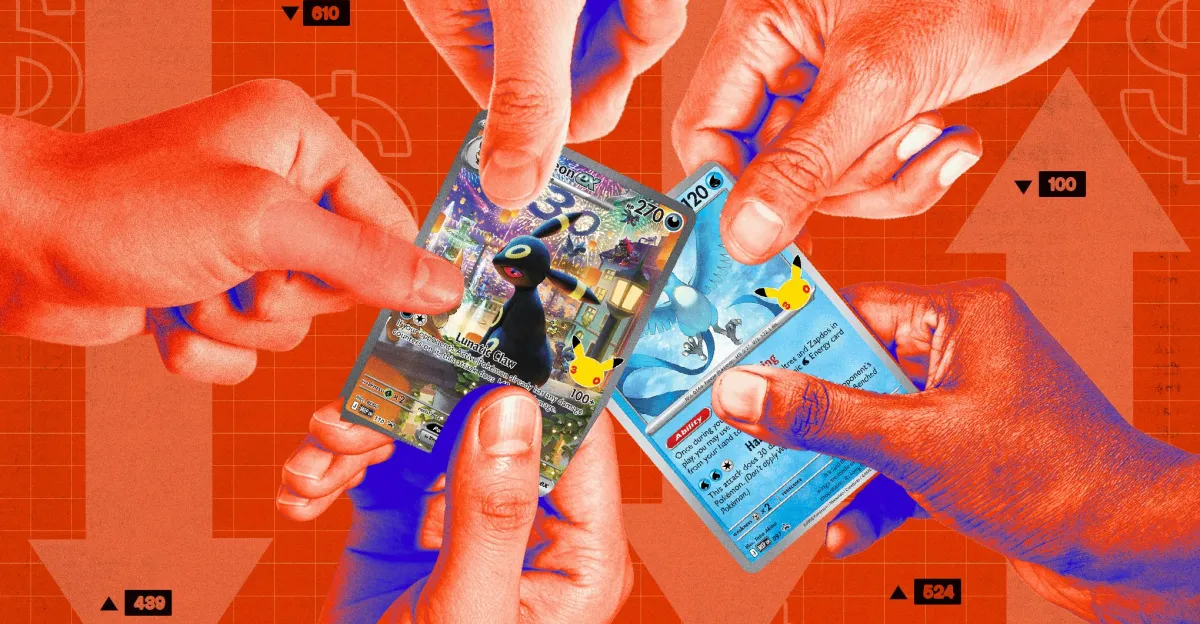
Earlier this month, Pokémon card content creator Natalie Roush posted a video to her YouTube and Instagram pages that enraged the larger collection community. In the now-deleted video, Roush shows off two premium boxes of cards that had not yet been officially released, and implores viewers not to be mad. But they were; other creators claimed that cards Roush had purchased were stolen from the manufacturer and mocked her for trying to sell them at exorbitant prices. The Roush situation was a high-profile example of the way Pokémon card collecting culture has been upended by the influencer economy and people trying to profit off the hobby. Though Roush has been relatively quiet in the days since the blowup, Pokémon collectors have been up in arms over a different — but very much related — problem.
When the Pokémon Trading Card Game’s long-awaited 30th Celebration set finally released last week, collectors across the country lined up outside of stores in hopes of getting their hands on some shiny pieces of cardboard. The anniversary set has unusually strong pull rates — the rate at which you’re likely to find rare “chase” cards in a given set — giving more fans the cards they’ve always dreamed of, and potentially upsetting the aftermarket Poké-conomy. Some diehard Poké-fans even camped out overnight because a resurgence in popularity has made the cards much more difficult to find and buy in person. But another group of Pokémon card hunters was able to secure the highly sought-after set without having to travel to physical retailers or navigate the online Pokémon Center.
Those people — resellers who often use automated bots to buy dozens of boxes of cards as soon as they’re available for preorder online — might not have had any intention of collecting the 30th Celebration set for themselves. But they have been trying to offload their spoils at marked-up prices to fans who haven’t had a chance to buy cards for themselves. Most retailers can’t keep cards on shelves, but there are plenty of videos online of resellers showing off piles of product they were able to obtain either by placing orders with bots or using inventory checking programs that alert them when brick-and-mortar stores receive stock. It’s also easy to find footage of resellers getting into altercations over cards, and in one recent instance, a 72-year-old man was arrested and charged with a first-degree misdemeanor for tracking a Pokémon delivery worker’s location with a device secretly planted in her car.
Though flipping trading cards is nothing new, the Pokémon reselling economy has gotten much bigger in recent years as people have taken note of how durable the franchise’s popularity is. Many resellers like BotterBoyNova started off with other kinds of valuable merchandise before realizing that Pokémon products can be sold for far beyond the manufacturer’s suggested retail price, or MSRP. When I spoke with Nova recently, he told me that — like many millennials — he’s been a Pokémon fan since the mid-’90s. Nova was originally a content creator whose videos were mostly focused on reselling sneakers, but seeing how easy it was to profit from reselling Pokémon products convinced him that he needed to get in on the action.
“Resellers in what’s described as the ‘Sneaker Twitter’ space are tapped in with practically every category of collectible that can resell for a profit,” Nova explained to me via Discord. “It’s not a situation where I’m singling out the Pokémon card market. It just so happens that it’s highly profitable and difficult to purchase for MSRP, and those are the conditions that our community specializes in.”
Rather than operating independently, Nova works with Polar Chefs — a “cook group” community that sells monthly subscriptions to a variety of reseller tools and services. Subscriptions range from $660 per year to $75 per month, and they come with access to Polar Chefs’ private Discord server, restock alerts, and a selection of bots that can be used to buy cards. These bots make it easy for people to create multiple accounts on retailers’ websites that are attached to virtual credit cards, while the buyer’s IP address is spoofed with proxies. Technically, this kind of process isn’t illegal — at least not yet; Congress outlawed concert ticket-focused bots in 2016 and lawmakers have proposed doing the same for retail bots. But it does violate most retailers’ terms of service, which is why some resellers’ orders are canceled.
Retail bots aren’t illegal, but they do violate most retailers’ terms of service.
Using Polar Chefs’ tools, Nova has been able to purchase massive amounts of Pokémon cards at MSRP from various retailers without being blocked by websites’ anti-bot security measures. Nova described his process of securing cards with bots as being “almost completely hands free,” and explained that the real work doesn’t begin until he has to sort and sell his inventory to a couple of bulk buyers.
“During most weeks, I spend less than 3-5 hours a week on the reselling side of things (setting up bots, buying inventory, selling and fulfilling inventory),” Nova said, noting that he’s commonly asleep while pre-programmed bots make purchases for him. “I wait for notifications to come in from Polar Chefs which inform me of releases, bot adjustments I need to make, etc.”
Though it is difficult to pinpoint exactly when Pokémon reselling really exploded in the past few years, the rise of groups like Polar Chefs feels reflective of the way that the creator economy evolved during the covid-19 pandemic. Resellers like Nova are influencers whose videos are designed to sell people on the idea that they could also be making money by flipping cards at scale. And monetized cook groups are prime examples of how online hustle culture has become more focused on the sale of how-to guides and courses for practices that can be seen as morally suspect.

There’s an argument to be made that the scarcity created by resellers is part of what has driven the popularity of platforms like Whatnot — an online marketplace where people can pay for things like sealed Pokémon products, which are then opened on livestreams by the seller before they’re sent to the buyer. Many Whatnot streamers present themselves as entrepreneurs who are providing their audiences with a helpful service while also entertaining them. But the platform has been accused of operating more like an illegal gambling operation, and there is an entire ecosystem of creators whose content documents Whatnot streamers scamming their customers.
But with the 30th Celebration packs flooding the market with rare cards, the scammers could be out of luck. Over the past week, X and Reddit have been inundated with screenshots from unnamed Discord servers where people claiming to be resellers appear to be melting down over not being able to sell their overpriced cards. One of the more widely circulated images features a person insisting that resellers are “the people that actually ensure [The Pokémon Company] makes money,” while complaining that “there’s literally no value in these sets because everyone can pull the rare bullshit.” In another, a reseller says they are filing a class action lawsuit against The Pokémon Company “for independent vendors who suffered severe financial asset devaluation due to artificial market saturation.”
The absurdity of these posts suggests that they might have been written by people making fun of actual resellers, as does the fact that while searching Discord I found some posts that use the exact same wording. Those posters might have just been looking for attention, but the state of the larger reselling economy does seem to be having a negative impact on Pokémon cards’ availability.
Even though The Pokémon Company is printing more cards than ever, almost everything about the modern aftermarket economy has made it harder for ordinary people — especially children — to participate in the hobby. Nova told me that he thinks casual collectors who just want to pull cool cards for themselves are completely justified in feeling that resellers are making Pokémon less accessible. He also believes that collectors whose interest in the cards is “incentivized by monetary gain” are hypocrites for taking issue with resellers. Aside from actually playing with them, the real fun of Pokémon cards is in the hunt and delight when you’re able to find a pack that shocks you with its contents. It’s an experience everyone’s supposed to be able to enjoy, but it’s being ruined by hustlers.